ON-PITCH
PERFORMANCE LAB
by OPP Football Group
Football keeps asking players to adapt to systems.We believe systems should adapt to players.
Because development is not about control — it's about understanding.
What we refuse to accept
Under 20 years we've perfected and optimized measurements.
Sprint counts. Heart rates. Distances. VO2 max. Accelerations. Training load. Jump height. GPS data.
The data grows.
But players burn out, get injured, become numbers.
How many were missed?
The 17-year-old who burns out
GPS data looked fine. His brain didn't.
The late developer who disappears at 14
The late bloomer never got the chance.
The methodology that dies in execution
When key coaches leave, the thread breaks.
The coach who knows something is wrong
No dashboard. No data. No system.
To identify talent is not creating it.
To measure players is not to develop them.
To collect data is not to build a pipeline.
The blind spot isn't the tools.
It's the thinking.
We refuse to accept this.
Scene 1/7
Who this is for
When the scouting system starts working, it's already too late.
Either you've created a talent pipeline or you didn't.
Training methodology doesn't live in PDFs. It doesn't live in PowerPoints. It lives out on the pitch. In the drill. In the task constraints. In the environment. In the rewarding. In the consequences.
This is for those who already know this. Who live it. Who refuse to pretend otherwise.
For the Clubs
Who build, not buy.
Who don't wait for scouts to validate what they've built. Who create pathways before they need them. Who know grassroots to elite is a decade-long conversation, not a scouting event.
For the Coaches
Who design environments.
Who design environments, not just exercises. Who understand the pitch is the classroom. Who care about the player's brain as much as their body. Who architect learning, not just training.
For the Leaders
Who make systems survive.
Who refuse to let methodology live in documents. Who build systems that survive staff changes. Who know the difference between talking about development and actually executing it.
We work with clubs who think in decades, not seasons. Who build pipelines, not scouting reports.
Most performance platforms live here.
Scroll to explore
From surface to core.
The future we're building
One philosophy.
A thousand pitches.
What if your best player was being developed right now — 8,000 km away — by coaches who think exactly like you?
The truth
See it in action
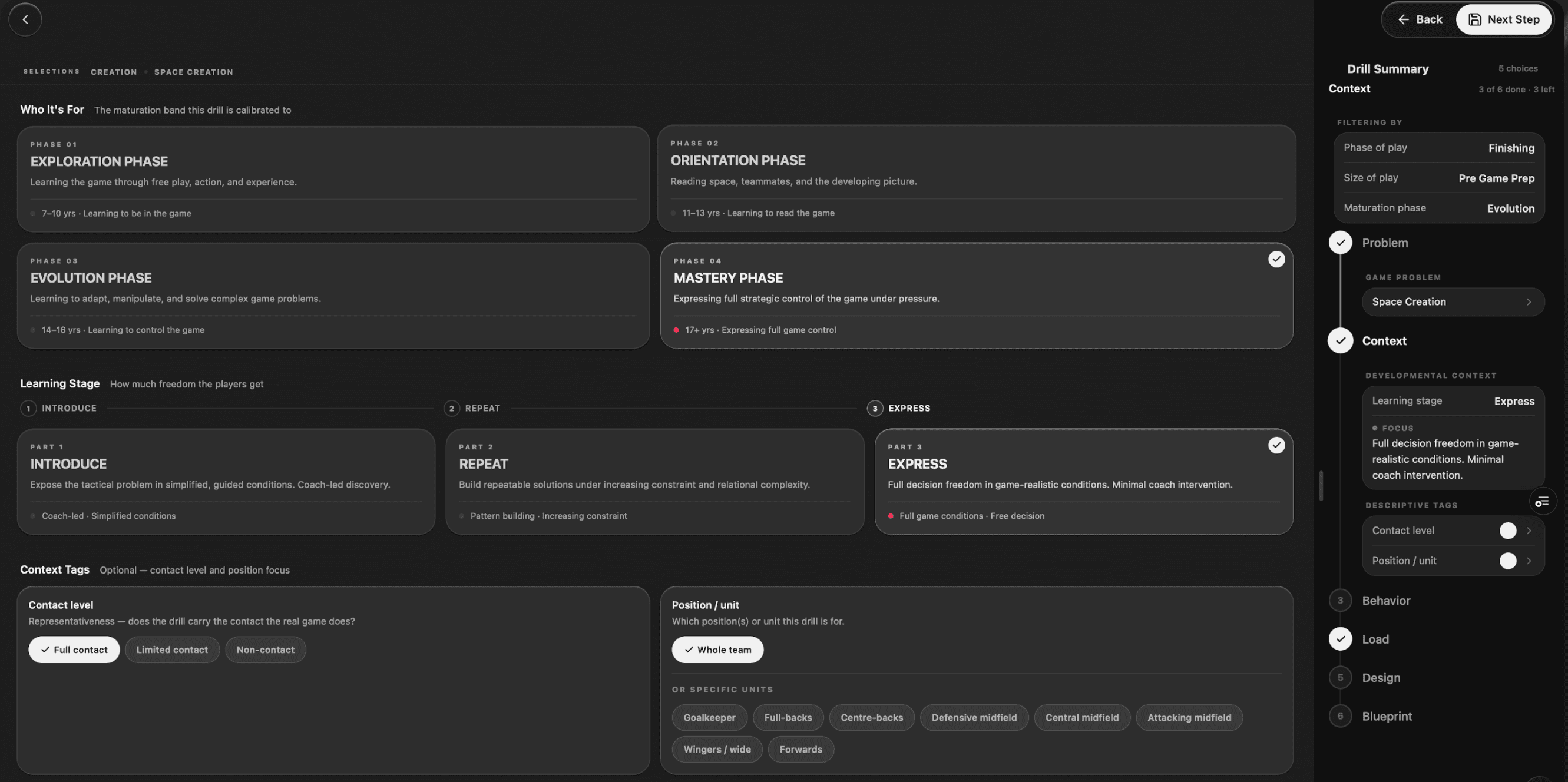
Every drill creates a decision landscape. We make it visible — so you can architect environments that challenge exactly what you intend.
Over Time, This Creates
Vertical High-Pressing Team
Long narrow pitch + Pressing rewards create players who hunt the ball
Players develop
"This is environment design. This is how On-Pitch helps clubs create the players they want."
What we built
A system where methodology actually gets executed
Not another dashboard. Not another tracking tool. A complete operating system — from how drills are designed, to how seasons are planned, to how every player develops.
Every component exists to protect one thing: developmental intent.
Design with intention
See the cognitive landscape before you hit the pitch. Set constraints, preview load, understand what you're actually training.
See the full picture
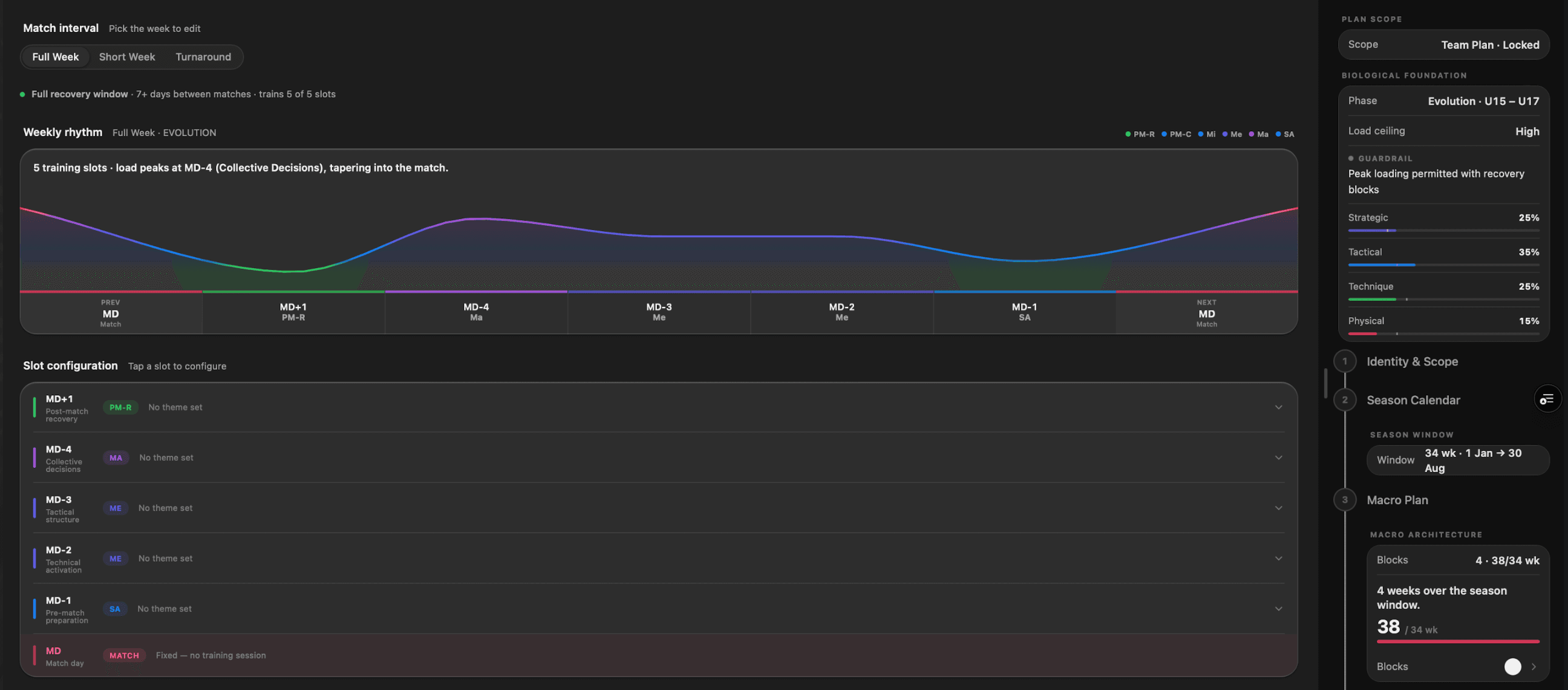
Cognitive load mapped across weeks. See when you're pushing. When to back off. Prevent burnout before it happens.
Know every player
Not just numbers. Growth patterns, learning profiles, maturity. The full picture of who they are and where they're going.
Compose sessions
Build sessions with total cognitive demand visible. Balance phases. See load before you execute.
Your philosophy, codified
Your game model becomes the foundation. Playing principles connect to training priorities. Every coach executes the same philosophy. Staff changes don't break the chain.
Everything connects
One system. No gaps. Plans show up in sessions. Design tracks to players.
No guessing work. Just optimized development plans.
Our algorithms analyze player data, load, and performance to automatically calculate your team's phase progression levels – creating holistic development plans that match where you actually are.
AI-calculated phase levels
Algorithms analyze PAH, PTC, load patterns, and match performance to determine your exact progression level in each phase.
Holistic development plans
Training sessions, load management, and cognitive challenges are automatically aligned to your current phase progression.
Real-time adjustments
As players develop and load changes, the system recalculates and adjusts your development plan automatically.
Phase Progression
Calculated by AI algorithms
Build-Up
Level 3
Set Up
Level 3
Creation
Level 3
We've always measured weights in the gym. Now we measure the brain.
You know when to take weight off the bar or add more. We do the same for cognitive and physical load – automatically calculating what your team needs right now.
Real-time load optimization
Team DNA tracks cognitive and physical load, automatically suggesting when to increase or decrease intensity – just like adjusting weights in the gym.
We're first. It should be obvious.
No one else measures cognitive load like this. It's time to treat the brain with the same precision as the body.
Team DNA
Real-time load optimization
Within target range
Within target range
Optimizing conditions with data-driven groupings
We find the perfect balance between research-based combinations of biological maturity banding and PTC skills based on perception-action coupling and mental components.
Biological maturity banding
No one misses opportunities due to late biological maturity.
Perception-action coupling
Talent identified through cognitive skills, not just physical advantages.
Equal opportunities
Everyone gets the same conditions for development.
Data-Driven Grouping
Research-based player optimization
Hover over zone labels to isolate groups • Click players to view details
How we calculate cognitive load in real-time
Move your cursor into crowded areas to see cognitive load increase. The timer ticks up (red) when density is high, and down (white) in open spaces – just like in real training.
Density-based calculation
Cognitive load increases when players are in crowded areas with high decision density and spatial awareness demands.
Real-time feedback
The system continuously calculates cognitive load based on proximity, decision moments, and spatial complexity during live training.
Automatic adjustments
When cognitive load is too high, the system suggests simplifying. When it's too low, complexity increases to maintain optimal challenge.
Cognitive Load Calculation
Interactive density visualization
Hover to see cognitive load calculation
Move into crowded areas to see load increase
Orange lines: Press directions from opponents. Multiple directions = higher cognitive load.
Green lines: Passing options to teammates. More options = more decisions = higher load.
Move between formation lines to see how pressure zones affect cognitive load in real-time.
Work and rest periods adjust to match your team's intensity level
No team has the same values. Everything is based on your team and adjusted through development and interactive feedback.
Adaptive intervals
Work and rest periods within each exercise are automatically adjusted to match your group's intensity level – calculated in real-time.
Physical load integration
On days with higher physical load, work periods decrease and rest periods increase. On lighter days, the opposite happens – ensuring optimal recovery and performance.
Team-specific values
Every team is different. Values are calculated based on your team's data, development stage, and adjusted through interactive feedback during sessions.
Live Training Mode
Adaptive interval timer
Set 1 of 5
Work Period
30s
Rest Period
30s
Physical load: high
Intervals adjusted automatically based on team intensity level
From data to decisions in three steps.
Capture what matters, understand what's at risk, act on concrete plans.
Stop chasing spreadsheets. See who's overloaded, under-challenged or drifting.
Know who to push, protect or involve more. Align coaches on next targets.
Move from "what can we do?" to "this is what today should be about."
Data everywhere. Decisions nowhere.
Most clubs have GPS, wellness, growth data and video. Very few have a clear answer to: "What should we do with this group this week?"
Physical load, everywhere. Cognitive load, almost nowhere.
Clubs track GPS and RPE – but not the decision load players face.
Talent ID snapshots – but few environments that create talent.
Scouting focuses on moments. Development is about the environments players live in every week.
Data silos – coaches still have to guess.
Information lives in different tools. We pull it into one language and one place.
Physical load
- Risk of overload, injury or burnout
- How demands stack across the week
- When to back off for long-term development
Cognitive load
- Physically fine but mentally under-challenged
- True decision moments per session
- When to simplify vs increase chaos
Built for clubs, coaches and athletes.
Three perspectives on the same reality – so leadership, staff and players all see where they are and where they're going.
- See how each age group tracks against your game model and philosophy.
- Align long-term plans with weekly training and match demands.
- One language for PAH, PTC, load and health across the club.
- Understand the real state of your squad before you plan the week.
- Design sessions that match game model, readiness and risk.
- Use live dashboards while you coach, not just in the office.
- See more than "coach likes me / doesn't like me".
- Understand how load, maturity and PTC shape the work you do.
- Get individual focus areas that connect training, matches and long-term goals.
Questions you might have
Before you ask...
We've thought about these too.
How do you measure something invisible?
We analyze the decision landscape — player positioning, passing options, pressing threats, and time pressure. Each drill creates a measurable cognitive signature. What was once intuition becomes data.
Still have questions?
Let's talk.
Football keeps asking players to adapt to systems.
We build systems that adapt to players.
If development shouldn't be left to chance — if you're ready to build a system that understands your players — we should talk.
We partner with a limited number of clubs each year.